
Realistic Hair Type 3C curly hair
Pencil corkscrews — the tightest Type 3 spring, often argued with 4A.
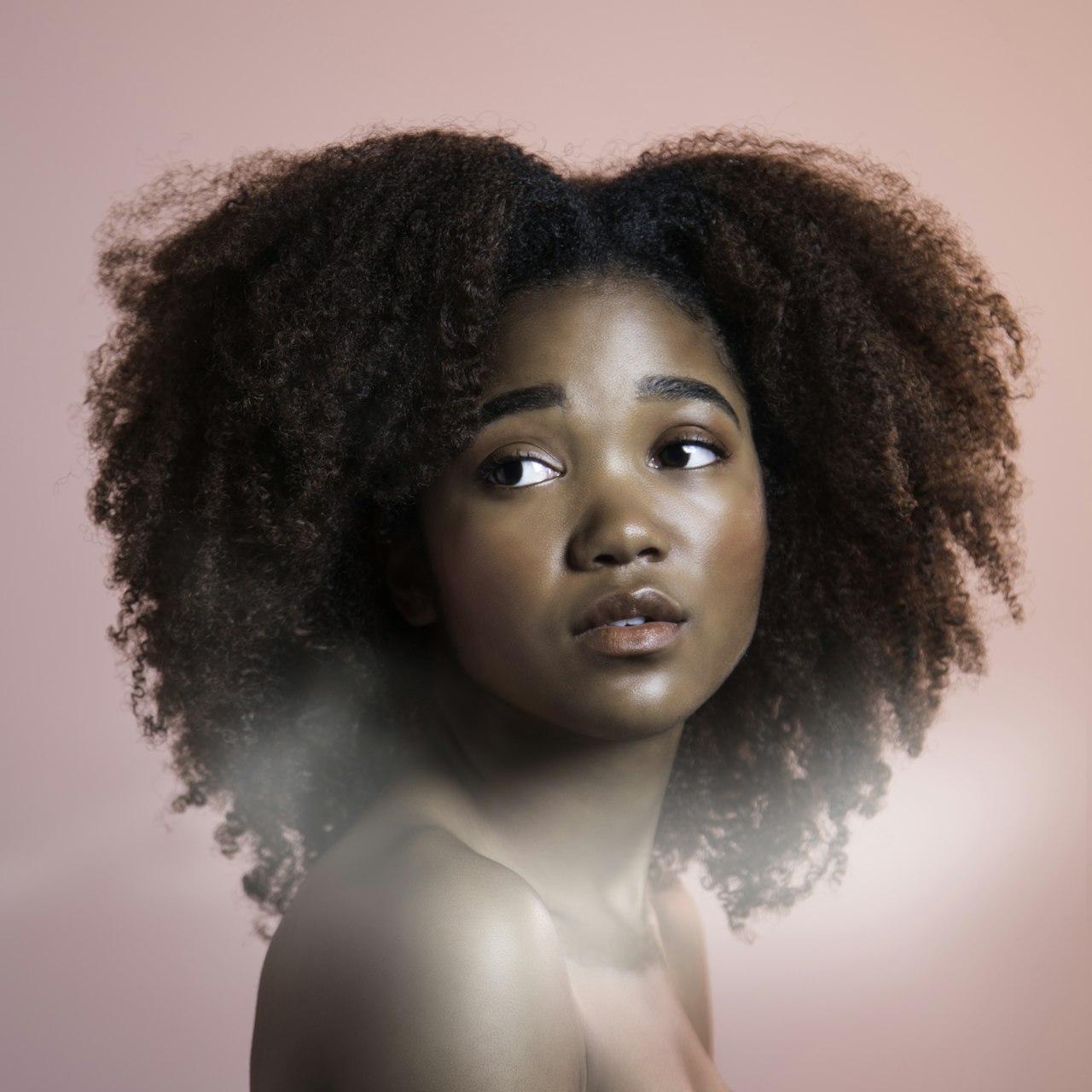
Type 3C is the tightest letter inside Walker’s curly family on the charts people search today: corkscrews that wrap near pencil or drinking-straw width. Volume is often huge. Shrinkage jumps compared with 3A and 3B. In the mirror, dry 3C still reads as a spiral or corkscrew when you look at a clump — that visible helix is the practical border with early 4A, where the coil may look like a small spring or S only after you isolate and stretch a strand.
Walker’s book and the later 3C letter
Andre Walker’s Andre Talks Hair! (Simon & Schuster, 1997) published numbered families with letter grades, but the internet’s full 3C grid is not a frozen facsimile of every line in that hardcover. Community charts — including NaturallyCurly-era infographics — filled and popularised 3C (and 4C) after 1997 so denser corkscrews had a search label. This wiki treats 3C as a real styling bin people need, and it dates the fill-in on typing systems. The letter remains shorthand, not morphometry. De La Mettrie et al. (2007) would still prefer a continuous curvature scale.
Pencil corkscrews in practice
Use a clean air-dry without styler. Wrap one dry curl around a pencil. A stable tight spiral that packs close is classic 3C language on Mayvenn- and Curl Centric-style diameter charts and on the hair type chart. If the loop is clearly marker-wide and open, stay nearer 3B. If dry hair is a dense mass with little visible corkscrew until you stretch a single fibre, also open coily hair and Type 4A.
Mixed 3B/3C and 3C/4A heads are common. Prefer the tighter pattern for moisture load and gentle handling, then read both pages. Identification method: identify your hair type.
Shrinkage is geometry
Community charts often place Type 3 shrinkage below Type 4, but 3C can still lose a large share of vertical length when dry. Ear-length dry and shoulder-length wet is ordinary helix behaviour, not proof the hair “will not grow.” Constant heat-stretching to photograph length is how ends thin. Longer notes on measuring and protecting length sit on hair shrinkage.
More bends per centimetre also means more friction sites. Detangle with slip, ends toward roots, on wet or very damp hair. Dry brushing 3C is a fast path to a frizz cloud and broken pieces.
Versus 4A — the expensive border
3C still shows a corkscrew in the dry mirror. 4A is a smaller S- or O-coil, often about crochet-needle width on wrap charts, with shrinkage commonly cited near 50 percent. Wash-and-go definition is easier to photograph on 3C; 4A may need more sealing and still look fluffier from a distance. Border arguments belong next to 4A / 4B / 4C and the coily family page. Do not invent ancestry to settle the border — Callender et al. (2026) and Koch et al. (2020) both push shape, not race.
Moisture, film, and porosity
3C usually wants more cream than 3A and a real gel or jelly film if you care about clumps in humidity. Layering on soaking hair matters more than brand mythology. Porosity still vetoes copied routines: low-porosity 3C rejects heavy butter until warmth and time help; high-porosity 3C drinks water and is dry two hours later. Run porosity and the porosity test. Protein schedules belong on protein versus moisture, not on a forever “3C checklist.”
Care map for Type 3C
- Cleanse the scalp; condition with serious slip; detangle in sections.
- Leave-in and cream on soaking hair; finish with gel; leave the cast until fully dry.
- Diffuse on low or air-dry without touching mid-dry clumps.
- Satin or silk at night reduces friction that looser types barely notice.
- Protective styles for stretch and convenience — pain at the scalp is a stop sign.
- Ordered routines: care by type. Film-forward wash days: curly girl method.
Family context
Read the whole Type 3 spread on curly hair. Compare soft spirals on Type 3A and marker ringlets on Type 3B. When the dry pattern stops looking like a corkscrew, cross into Type 4A and the types hub. Science under the spring: structure. Growth timing if shrinkage is confusing shed with loss: growth cycle.
3C is dense springy curly hair with a community letter that arrived after Walker’s first book. Treat it as geometry plus care load — not as a personality, and not as an ethnicity code.
Frequently Asked Questions
Quick answers to the most common questions.
Did Andre Walker include 3C in 1997?
Walker published Type 3 with letter grades, but the popular 3C grid people search today was filled out and spread by later community charts. See typing systems for the paper trail.
How do I tell 3C from 4A?
Why is my 3C so short when dry?
Shrinkage. The helix occupies less vertical length. Wet or gently stretched length is the fairer growth check — details on hair shrinkage.
Does 3C need heavier products than 3A?
Usually yes — more cream and a stronger film are common — but porosity and density can veto that. Confirm cuticle behaviour on porosity before copying a dense-coil routine.